

The Question That Stops People from Buying
You’re ready to finally fix your mosquito problem.
You’re researching the best solar mosquito zapper, comparing models, reading reviews… and then you see it:
“Bug zappers attract more bugs than they kill.”
Now you’re second-guessing everything.
What if you spend $119 on a solar bug zapper and end up turning your yard into a mosquito party? What if you’re literally installing a glowing insect billboard?
Let’s clear this up — with science, real-world experience, and smart placement strategy.
Because yes, solar bug zappers attract bugs.
And that’s exactly why they work.
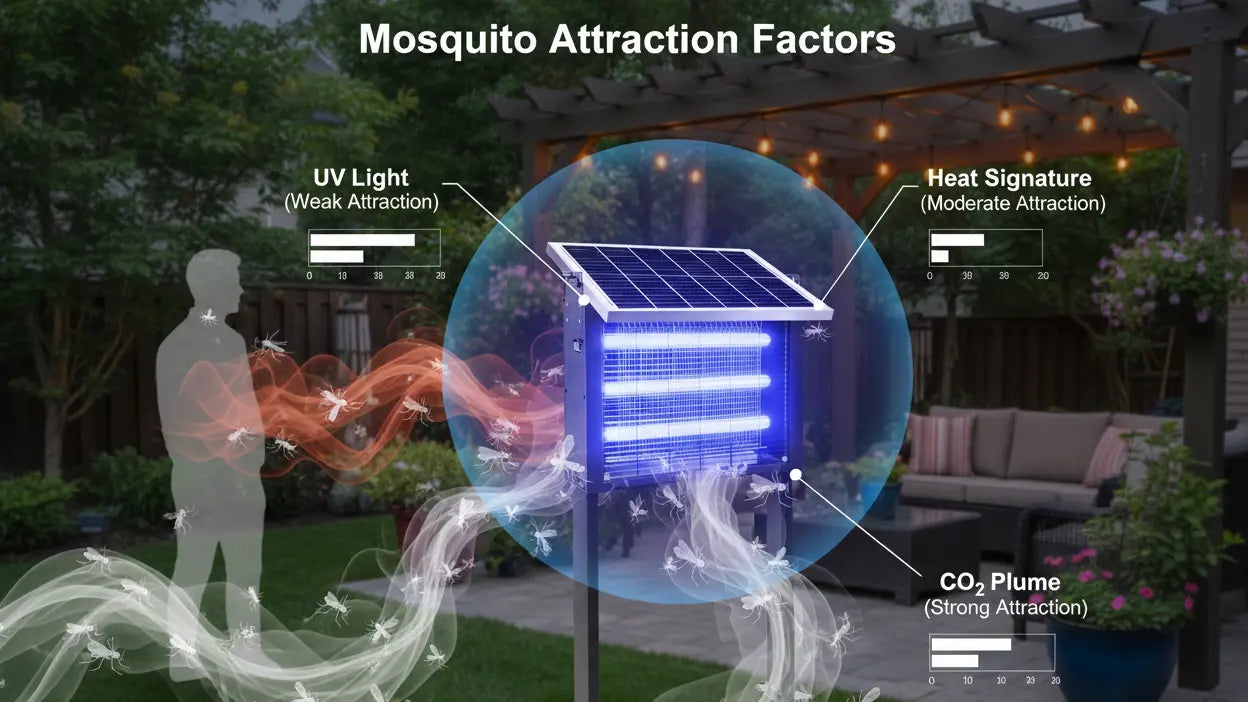
First: What Actually Attracts Mosquitoes?
Before we answer whether solar bug zappers attract more bugs, we need to understand what attracts mosquitoes in the first place.
Most people assume it’s light.
It’s not.
1. Carbon Dioxide (CO₂) – The Main Driver
Mosquitoes detect carbon dioxide from up to 100 feet away. Every breath you exhale creates a CO₂ plume that drifts through the air. To a mosquito, that plume is a glowing sign that says:
“Warm blood here.”
This is the strongest long-range attractant.
Your solar mosquito zapper does not emit CO₂.
You do.
2. Body Heat – Close Range Lock-On
Once mosquitoes get closer, they detect infrared heat signatures. Warm skin pulls them in.
The zapper does not produce body heat.
You do.
3. Body Odor & Sweat Chemistry
Certain compounds in sweat — like lactic acid and ammonia — are mosquito magnets. That’s why some people get bitten more than others.
The zapper doesn’t sweat.
You do.
4. UV Light – Yes, But It’s Weaker
Mosquitoes are attracted to specific UV wavelengths, which is why high-quality solar bug zappers use UV LEDs.
But UV light is not stronger than CO₂ or body heat.
This distinction is critical.
So Do Solar Bug Zappers Attract Bugs?
Yes.
They absolutely attract flying insects.
That’s their job.
But here’s the key question:
Do they attract NEW mosquitoes into your yard that wouldn’t have come otherwise?
In most cases, no.
Mosquitoes:
-
Breed locally (standing water)
-
Rest locally (vegetation)
-
Hunt locally (you)
They are already in or near your yard.
A properly placed solar mosquito zapper doesn’t import mosquitoes.
It intercepts them.

The Real Issue: Placement Determines Everything
This is where most people go wrong.
If you hang your solar bug zapper directly over your patio table where you’re sitting, you create competing signals:
You = CO₂ + heat + scent
Zapper = UV light
Mosquitoes get mixed signals and may hover around your activity zone.
This is where the myth starts.
The Correct Placement Strategy (Explained Clearly)
To make the best solar mosquito zapper work properly, you need to create an interception zone.
Ideal Setup:
• 15–20 feet away from where you sit
• Between your seating area and mosquito breeding zones
• 3–6 feet above ground
• In full sun for charging
What happens now?
Mosquitoes traveling toward your CO₂ plume encounter the UV light first.
They investigate.
They contact the grid.
They’re eliminated.
They never reach you.
This is not attraction into your yard.
It’s interception inside your yard.

How Far Do Solar Bug Zappers Actually Pull From?
You may hear exaggerated claims like:
“They attract mosquitoes from miles away.”
That’s not how light physics works.
Realistic effective attraction range:
30–50 feet.
Visibility range may be farther, but visibility ≠ irresistible pull.
Remember:
Your CO₂ plume travels farther than UV light does.
You’re the stronger beacon.
Why Solar Mosquito Zappers Are Superior to Plug-In Models
This is important.
Solar models allow strategic placement.
No outlet dependency.
No extension cords.
No forced positioning near your house.
You can:
• Place it near vegetation
• Set it near fence lines
• Install it along yard edges
• Create perimeter defense
That flexibility is why premium solar mosquito zappers outperform cheap plug-in units.
Let’s Talk Research (Because This Gets Misquoted)
You may read that studies show bug zappers catch more moths than mosquitoes.
That’s true.
But here’s what’s misunderstood:
The metric isn’t:
“What percentage of total insects are mosquitoes?”
The metric is:
“Are you getting bitten less?”
If mosquito encounters drop, the device is working.
And when placed properly, they do reduce mosquito encounters.
Integrated Mosquito Control (Why Layering Wins)
The best outdoor mosquito control strategy combines:
-
Eliminate standing water
-
Trim vegetation
-
Use fans on patios
-
Install solar bug zapper strategically
The zapper becomes your final line of defense.
Not your only defense.
This layered approach dramatically increases results.

Real-World Results Timeline
Week 1
You notice zapping sounds.
You’re unsure if it’s working yet.
Week 2
You’re swatting less.
Evenings feel calmer.
Week 3
You’re spending more time outside.
You stop thinking about mosquitoes.
Month 2
It becomes background protection.
Your outdoor space feels usable again.
That’s how the best solar mosquito zapper performs when positioned correctly.
Environmental Impact Explained
People sometimes worry about beneficial insects.
Here’s reality:
• Bees and butterflies are active during daylight
• Solar bug zappers activate at dusk
• Night catches are mostly mosquitoes and flying pests
Compared to:
• Chemical yard sprays
• Foggers
• Misting systems
A solar mosquito zapper is dramatically more environmentally responsible.
Cost Comparison (Long-Term Thinking)
Let’s break it down.
Bug spray: $60–$120 per season
Citronella candles: $50+ per season
Professional treatments: $300–$900 per year
Misting systems: $2,000+ install
A high-quality solar mosquito zapper:
• One-time purchase
• Zero electricity cost
• No recurring treatment fees
• Multi-year lifespan
It pays for itself quickly.

Who Benefits Most?
This is ideal for:
• Backyard patios
• Outdoor kitchens
• Pool decks
• Farms and barns
• RV setups
• Garden seating areas
• Lake houses
• Campsites
If you value outdoor time, this is one of the smartest upgrades you can make.
Frequently Asked Questions (Expanded)
Will it attract mosquitoes from my neighbor’s yard?
No meaningful evidence supports this. UV attraction range is limited. Mosquitoes are already hunting locally.
Should I turn off porch lights?
Bright white lights compete with UV. Switching to warm/yellow lights improves effectiveness.
What if I still get bitten?
Re-evaluate placement. Most issues are positioning errors.
Is one enough?
For small yards, yes. Larger properties benefit from perimeter strategy using multiple units.
Why This Is the Best Solar Mosquito Zapper Choice
A premium solar mosquito zapper should include:
• High-output UV LED system
• Strong electric grid
• 360° coverage
• 100–150m² protection
• Weatherproof housing
• Dusk-to-dawn automation
• Large rechargeable battery
• Zero wiring
When these features combine with proper placement, mosquito pressure drops significantly.

Final Verdict: Attraction vs. Elimination
Yes, solar bug zappers attract insects.
But when used strategically, they reduce mosquito encounters.
The difference between failure and success is not the device.
It’s positioning.
When properly installed, the best solar mosquito zapper becomes:
• A silent interception system
• A perimeter defense
• A zero-electricity solution
• A long-term mosquito control upgrade
No chemicals.
No monthly fees.
No cords.
No constant spraying.
Just smarter outdoor protection.